AI coding tools write boilerplate in seconds. That changes what a junior developer is hired for, and it should change what software engineering education trains. At 42 Berlin there are no teachers and no lectures. Students learn peer to peer, and other students review every project before it counts. The 42 model dates from 2013, years before AI assistants could write code. It happens to train the skills those assistants have made scarce.
What AI Changed for Junior Developers
Almost everyone uses the tools. In Stack Overflow's 2025 developer survey, 84% of respondents use AI tools or plan to. Among early-career developers, 55.5% use them every day.
Far fewer trust them. 46% of developers say they distrust the accuracy of AI output, against 33% who trust it. The most common frustration, named by 66%, is an answer that is "almost right, but not quite". 45% say debugging AI-generated code is more time-consuming.
Speed is less certain than it feels. In 2025 the research group METR ran a randomised trial with 16 experienced open-source developers working on 246 tasks in their own repositories. With AI tools allowed, the tasks took 19% longer. Afterwards the developers estimated that the tools had made them 20% faster. It is one small study of experts in large, mature codebases, and the authors do not claim it holds everywhere. It does show that feeling productive and being productive are two different measurements.
Entry-level work has moved too. Stanford's Digital Economy Lab found that employment for software developers aged 22 to 25 in the US fell nearly 20% from its late-2022 peak by July 2025, while employment for older developers kept growing.
Our reading: typing code was the part of the junior job that AI took first. What is left is the part that takes understanding.
The Junior Developer Skills That Matter in 2026
This list is our reading of the data above, not a survey result.
- Reading code you did not write, whether a colleague wrote it or a model did.
- Debugging, which now often means finding out why an answer is almost right.
- Explaining a trade-off to someone who disagrees with you.
- Reviewing code, and saying no when it is not good enough.
- Deciding what to build before you ask a tool to build it.
You do not pick these up from a lecture. You pick them up by doing them with other people, repeatedly, on code that matters to someone.
How Peer Evaluation Works at 42 Berlin
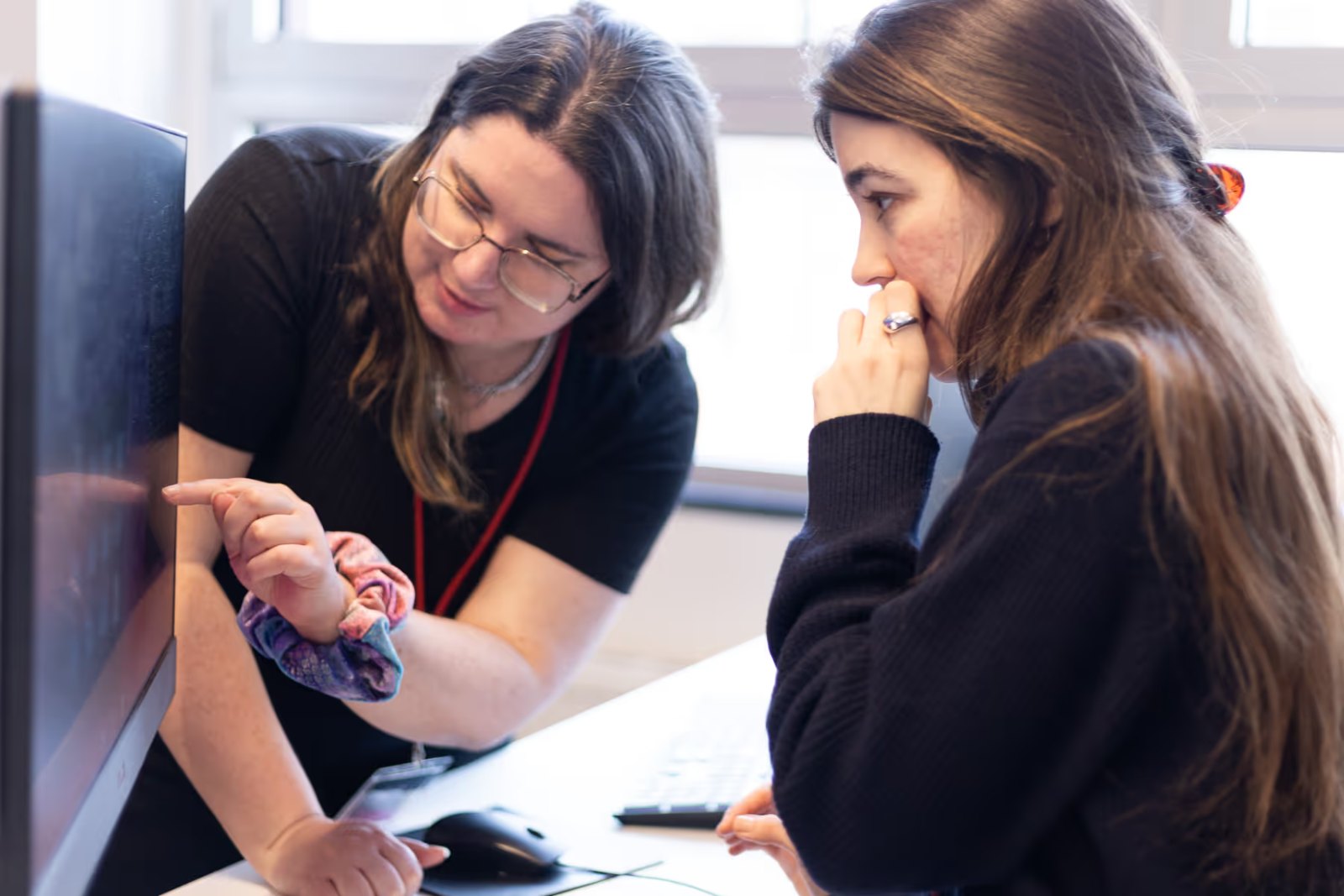
The method is easy to describe. You get a project and no instructions for solving it. When you think it works, another student evaluates it. They sit next to you, run your code and ask you to explain what it does and why. Then they decide whether it passes. Later you are the evaluator, reading a stranger's answer to a problem you solved differently.
This starts in the Piscine, the 26-day selection every applicant goes through, where all daily modules are evaluated peer to peer. It continues through the curriculum, where reviewing the work of your peers is part of how you progress.
Finn came to 42 Berlin after studying computer science at university. He arrived knowing C and found he could not always explain it. "In a lot of cases, I didn't fully understand the topic," he says. Explaining it to someone else sent him back to revise, then to explain it again.
Dan, who moved to Berlin to lead the pedagogy team, made the same point in 2023. Students spend much of their time reading each other's code and learning to talk about their own, and those are the skills a company needs from an engineer.
Code Review Training From Day One
In industry, code review is where much of the learning happens. A 2013 study of code review at Microsoft found that developers mainly expect reviews to catch defects. What reviews deliver in practice is broader: knowledge transfer, team awareness and alternative solutions to problems.
A 42 evaluation is the same practice, started early. Three habits come out of it.
Reading Before Judging
You cannot evaluate code you have not understood. Evaluators learn to read an unfamiliar solution quickly and to find the line where it breaks.
Defending Your Decisions
You explain each choice to a peer who is allowed to ask why. Code pasted from a chatbot is the hardest code to defend. That is one reason the curriculum takes AI in three steps: avoid it at first, adopt it for tedious tasks, then use it as a coding partner.
Giving a Verdict
An evaluation ends with a pass or a fail, decided by you, about someone you will see at lunch. It is good practice for the hardest part of review at work, which is saying no politely and meaning it.
What the Research Says About Peer Learning
The best evidence comes from university classrooms, not from schools like ours. A 2013 study of four computer science courses over ten years compared standard lectures with peer instruction, where students discuss questions with each other during class. Fail rates fell by an average of 61%, from 20% to 7%.
Peer instruction in a lecture hall is not the 42 model, so the study does not prove that ours works. It does support the mechanism. Students who explain answers to each other fail less often than students who only listen.
Where Peer-to-Peer Coding Falls Short
It is slower at the start. Nobody hands you the answer, and your evaluator may know as little as you do. Some people learn better with a teacher and a timetable, and there is nothing wrong with that. The Piscine exists partly so you can find out which kind of learner you are before you commit.
42 Berlin does not award a degree either. If you need one, university is the right route. Our comparison of coding bootcamps, universities and 42 Berlin covers that choice.
Questions People Ask
Will AI Replace Junior Developers?
Nobody knows yet. The Stanford data shows employment falling for developers aged 22 to 25 while it grows for older ones. Our bet is that juniors who can review and debug what the tools produce will keep getting hired.
What Is Peer-to-Peer Learning in Coding?
Students learn from each other instead of from a teacher. At 42 Berlin that means project work without lectures, and peer evaluation: another student reviews your project and decides whether it passes.
Do 42 Berlin Students Use AI Tools?
Yes, in stages. The curriculum asks students to avoid AI at first, then adopt it for tedious tasks, then master it as a coding partner. A later module covers LLMs, prompt engineering, RAG and agentic AI.
Start With the Piscine
The Piscine is 26 days of C, shell and peer evaluation. There are no tuition fees and you need no coding experience. Read why we start with C and the command line, see what students did next in the stories, or apply.
42 Berlin