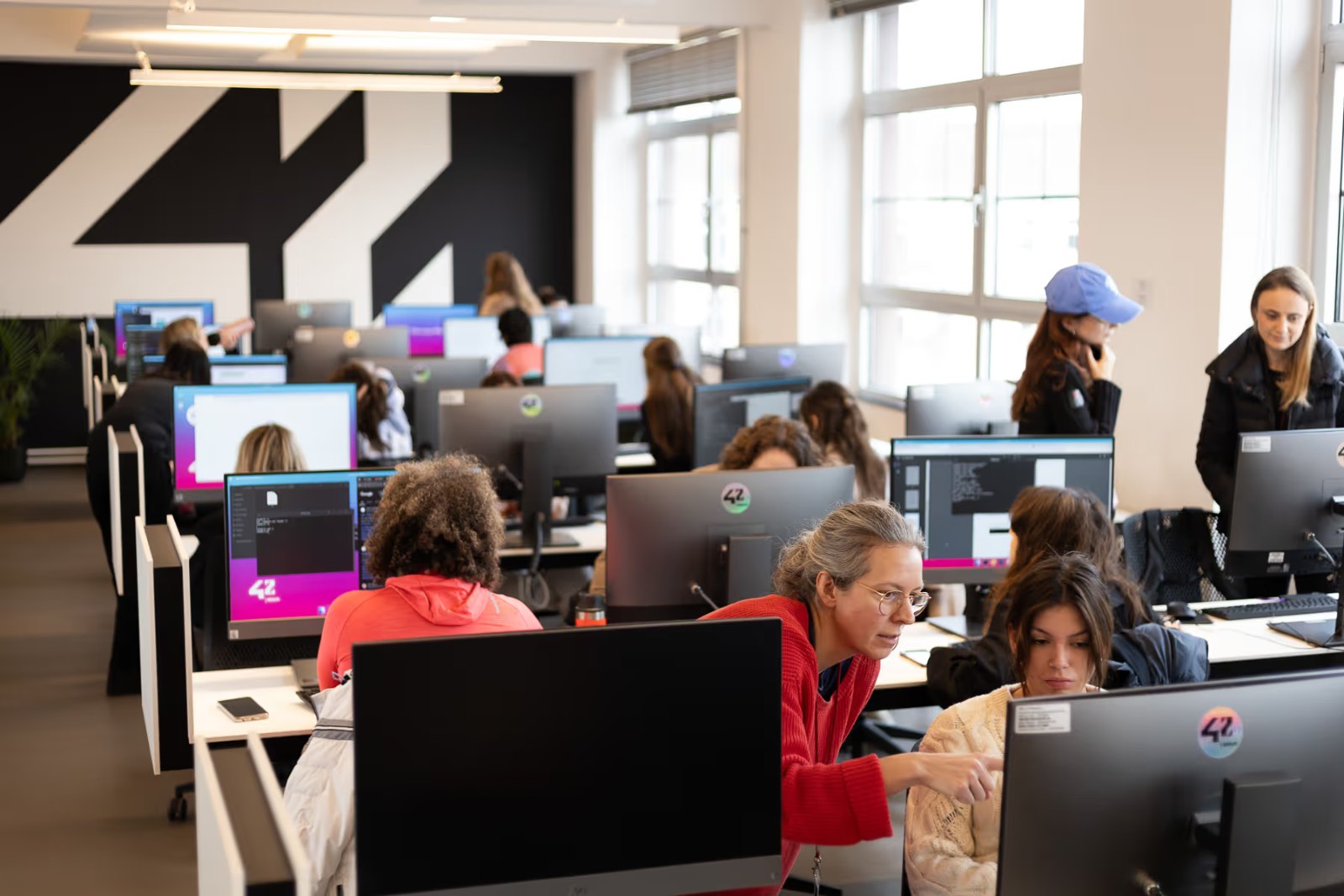
If you are weighing up a coding bootcamp in Berlin against a computer science degree, you have probably come across 42 Berlin and wondered which of the two it is. It is neither. A bootcamp is a short, paid, taught course. A university gives you theory and a degree over several years. 42 Berlin is a tuition-free coding school with no teachers, where you learn software engineering by building things with other people. This is how the three models compare, and who each one suits.
42 berlin vs coding bootcamp vs university: the short version.
| 42 Berlin | Coding bootcamp | University (computer science) | |
|---|---|---|---|
| Tuition | €0. No fees before, during or after. | Around €8,000 to €14,000 for a full-time course. Often €0 with a Bildungsgutschein. | No tuition fees at public universities in Berlin. A semester contribution of around €300 to €360. |
| Duration | 12 to 18 months for the core curriculum, at your own pace. Then a 4 to 6 month internship. | Usually 9 to 12 weeks full-time, or up to 6 months part-time. | 6 semesters for a bachelor's, on paper. |
| Getting in | 18 or older. No degree, no coding experience. A four-week trial called the Piscine. | An application and usually an interview. No degree needed. | Abitur or an equivalent qualification. Some courses have a grade cut-off. |
| Teaching method | No teachers, no lectures. Projects reviewed by other students, on a campus open 24/7. | Instructor-led, on a fixed timetable, usually around one tech stack. | Lectures, exercise classes and exams. |
| What you leave with | Reviewed projects, from C to Python and AI, and work experience. No degree. | A certificate from the provider and a few portfolio projects. | A state-recognised degree and a strong grounding in theory. |
is 42 berlin a coding bootcamp?
No, although plenty of people search for it as one. A coding bootcamp is short, paid and led by instructors, and it is usually built around one tech stack. 42 Berlin runs for a year or more, charges nothing and has no instructors at all.
The closest thing to a bootcamp at 42 is the Piscine: 26 days of C and shell, seven days a week, with every exercise reviewed by another candidate. It is also the last step of admissions. Dan, who went through the Piscine at 42 Paris and went on to lead the pedagogy team in Berlin, describes it as a selection "not just for the school but also for yourself".
what makes the 42 model different.
c before frameworks.
The curriculum starts in C. Early on you write your own version of the C standard library. Later you build a working shell. Finn came to 42 Berlin from a computer science degree and says that project, Minishell, shaped him more than any other. It "removed the black box" that a shell had always been to him.
Python and AI come next, once you know what the machine is doing underneath. AI tools follow the same order: none at first, then for the tedious parts, then as a coding partner. Frameworks come and go every few years. Memory, processes and the command line have barely moved in decades.
nobody hands you the answer.
There are no lectures and no teachers. You get a project, which is a problem to solve, and you work out how. "It's not necessarily about the answer but how you get to the answer," says Dan. When you are stuck you ask the person next to you. If they don't know, you ask the next one. Being stuck is part of the design, and getting yourself unstuck is the skill you practise most.
other students review your work.
Every project is evaluated by other students, and you evaluate theirs. Explaining your code out loud is where the gaps show. Finn arrived with a head start in C and still found that "in a lot of cases, I didn't fully understand the topic". Months of team projects taught him something else: to give his ego "the backseat", because the project matters more than being right.
what a coding bootcamp does well.
A bootcamp gives you speed and structure. If you already have a degree or a career and need one specific skill set quickly, twelve focused weeks can be the right tool. In Germany the fee is often covered by a Bildungsgutschein from the Agentur für Arbeit or the Jobcenter, which is how most "free coding bootcamp" offers in Germany work. Aurelie did a data science bootcamp before joining 42 Berlin. Only one person in that cohort paid the fee themselves, Aurelie told us in 2023.
The limits come from the same place as the speed. Aurelie describes those months as full-time, evenings and weekends included, and "very tiring". The course gave "fundamentals for a lot of things", and the job search afterwards was still a solo effort. Finn, who had written code before he looked at bootcamps, calls the promise of learning to code in 8 to 12 weeks "kind of a pipe dream".
what a computer science degree does well.
A degree gives you theory and a credential every employer recognises. Finn credits university with teaching him to "think abstractly" through advanced mathematics and logic, and the C he learned there gave him a head start in the Piscine. If you want to go into research, or you want the degree itself, university is the right choice.
What Finn missed was building. Group projects exist at university, he says, but they are smaller and shorter than the team projects at 42. In 2023 Fatma was studying technical informatics at a university and at 42 Berlin at the same time, which is one way to settle the computer science university vs coding school question. The university half ends in a bachelor's degree. The 42 half does not, and you should know that before you apply.
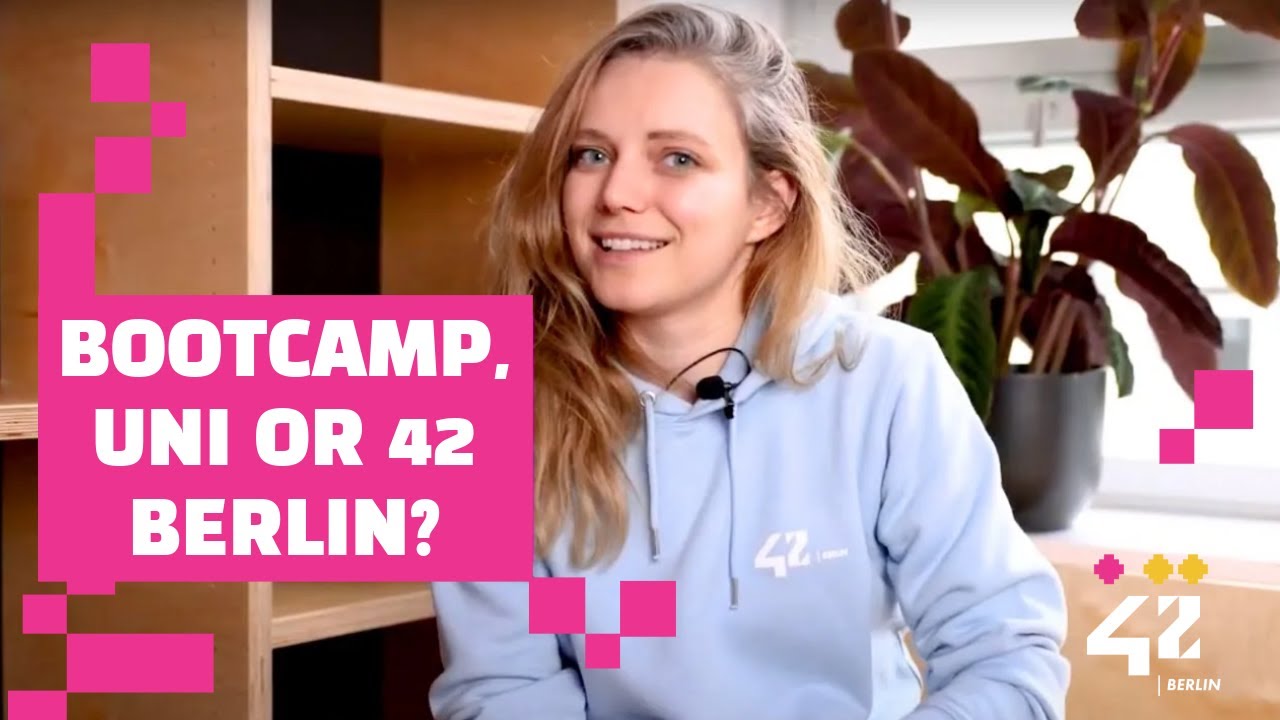
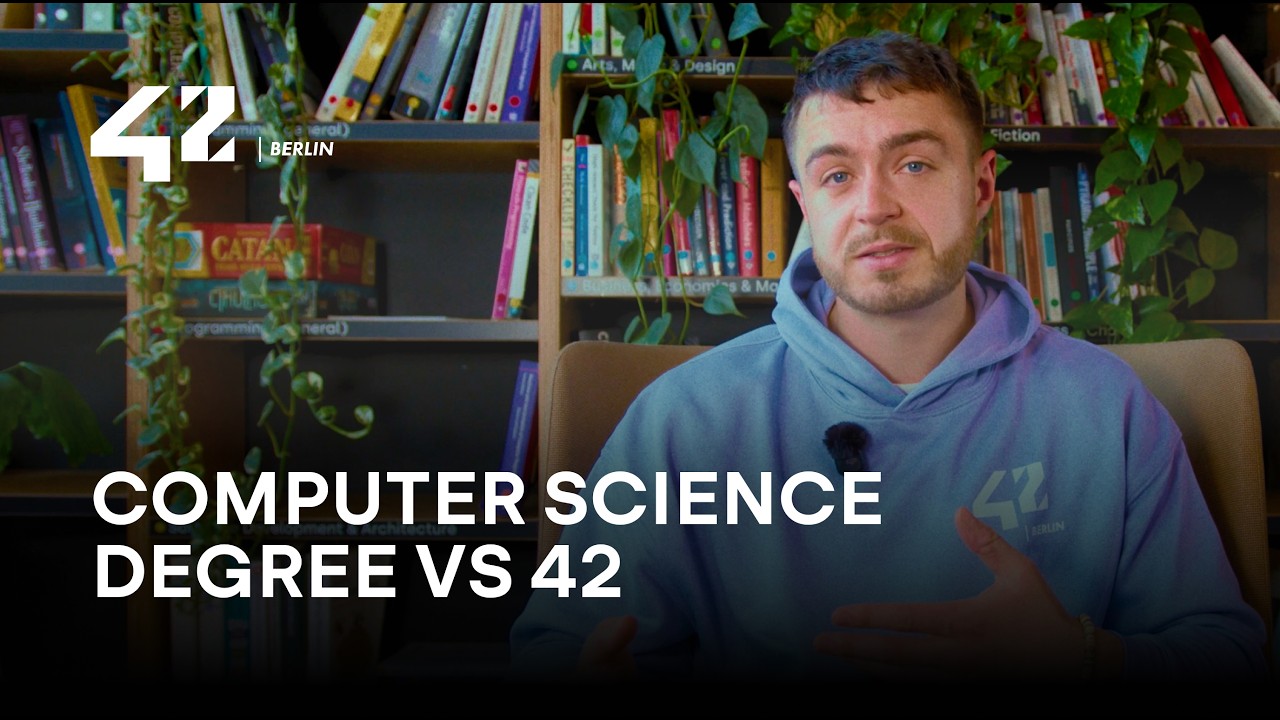
watch the comparison.
The people quoted above, on camera. Each video opens on YouTube.
what hiring managers look at.
In Germany, practical skill carries real weight. In a Bitkom survey published in October 2026, 69% of companies with IT roles said they employ career changers, and 51% said practical IT skills count for more than formal qualifications. Asked what those career changers typically bring, 35% named an IT course such as a bootcamp and 30% named self-taught skills.
The degree has not stopped mattering. A 2024 study by Harvard Business School and the Burning Glass Institute looked at large US employers that removed degree requirements from their job ads. The change affected fewer than 1 in 700 hires. In Stack Overflow's 2024 developer survey, 66% of developers held a bachelor's or master's degree, although only 49% said they learned to code at school.
Entry-level jobs have also become harder to get. Stanford's Digital Economy Lab found that employment for software developers aged 22 to 25 in the US had fallen nearly 20% from its late-2022 peak by July 2025, while employment for older developers kept growing. In Stack Overflow's 2025 survey, 66% of developers said their biggest frustration with AI tools is answers that are almost right, but not quite.
Our reading of this: the routine work that used to go to juniors is the work AI tools now do. What remains is the part that takes understanding. That means reading code you did not write, finding out why something is almost right and explaining a decision to a team. A certificate does not prove you can do that, and neither does a degree on its own. A technical interview tests it directly, whichever route you took.
which one should you choose?
- A coding bootcamp if you already have a degree or a career, need one specific skill quickly, and can pay the fee or get it covered.
- University if you want theory, research or the degree itself, and you learn well from lectures and exams.
- 42 Berlin if you want to build software for a living, can commit 12 to 18 months on campus in Berlin, and would rather work a problem out with other people than be told the answer.
42 is not the easy option of the three. It is a full-time, on-campus school. There is no degree at the end and nobody chases you to turn up. Tuition is free, but living in Berlin is not, and the Bildungsgutschein is currently not available at 42 Berlin.
The Piscine exists so you can find out before you commit. It takes four weeks and costs nothing. Start your application when you are ready.
questions people ask.
is 42 berlin really free?
Yes. There are no tuition fees before, during or after your studies. 42 Berlin is a non-profit. You pay your own living costs.
do you get a degree from 42 berlin?
No. 42 Berlin does not award a degree. You leave with a portfolio of reviewed projects, and the curriculum includes a 4 to 6 month internship. If you need the title, study at a university.
can you become a developer without a computer science degree?
Yes, and in Germany it is common. Bitkom found that 69% of companies with IT roles employ career changers. A degree still opens some doors that skills alone do not.
is there a free coding bootcamp in germany?
Many coding bootcamps in Germany are free if the Agentur für Arbeit or the Jobcenter grants you a Bildungsgutschein. 42 Berlin is not a bootcamp, but it is free for everyone it admits, with no voucher and no funding application.
do you need coding experience to apply?
No. You need to be 18 or older. No degree and no coding experience are required. More answers are in the FAQ.
42 Berlin