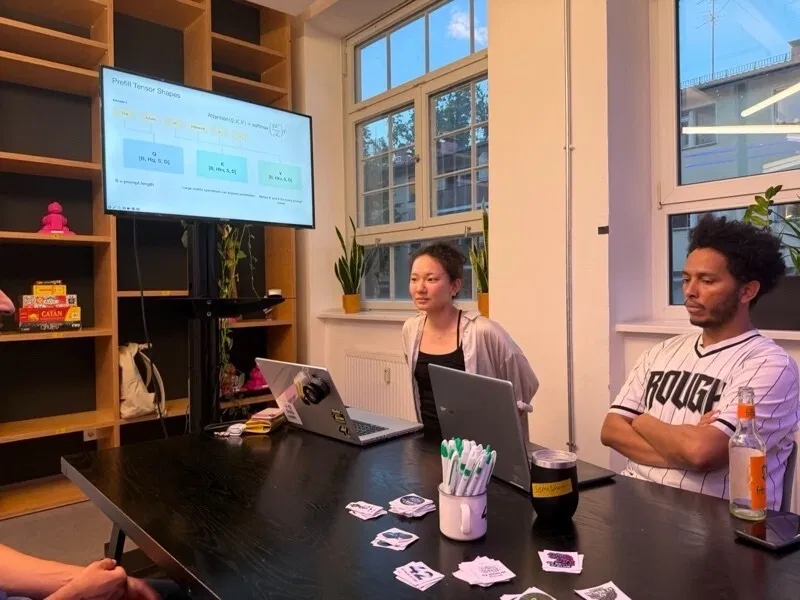
Subin came to 42 Berlin after studying abroad, once she realised how much she enjoyed living overseas. She wanted to find out what working as a developer in Germany was like, and 42 looked like an unusual but exciting place to start. It turned out to be more than a programming school. People from very different backgrounds learned, worked and spent time together there.
lost, then less lost.
She wouldn't call 42 simply hard. There were difficult projects and plenty of uncertainty. What she remembers more is the feeling of being lost at times, and then learning that the feeling doesn't last. Keep working, keep asking questions, try again, and things get clearer. She counts it among the most valuable things she learned at 42.
deep learning before linear algebra.
Back in Korea she returned to university and started taking upper-level electrical engineering courses, "rather boldly", in her words. She took an introductory deep learning course before she had properly studied linear algebra. The first grades were not much to look at.
The idea of mathematical modelling hooked her anyway. She liked the thought that some beautifully strange function might explain a complicated phenomenon. Then it turned out the same kind of idea describes language too, through language models. She took more courses in machine learning, deep learning and reinforcement learning, and kept studying maths on her own. Reinforcement learning stuck most, because it tied game theory and time-series analysis together in a way that was mathematical and practical at once. She still enjoys exploring those ideas, and lately has been trying them on financial analysis.
what happens underneath.
Learning AI through Python libraries such as PyTorch and NumPy left her with a nagging feeling. She was using powerful tools without knowing what happened underneath. How were the computations actually executed? Were they using the computer efficiently? How did every operation reach the hardware at the right time?
That sent her back to C++ and systems programming. Alongside the machine learning courses she studied embedded systems, logic design and computer architecture. Computer architecture was the one that connected the software abstractions to what happens inside a machine. From then on she saw AI as a systems problem as well as a model-training one: how to make computation run efficiently on real hardware.
the job.
Today Subin works in AI inference engineering, in C++. Her job is helping AI workloads make the best possible use of a device's computing resources. She is interested in the space between models and hardware: how computation is organised, executed and optimised in practice.
Next on her list is distributed computing. As hardware gets more expensive, scheduling, power limits and how to share work across the available compute matter more. It isn't her main area yet, but she wants to keep learning about it. She also cares a lot about well-abstracted code: code that works today and that people can still understand and adapt when the system grows.
her advice to current students.
Don't focus only on collecting knowledge or finishing projects. The people, the collaboration and the resources around you are part of the experience too. She admits she didn't always use them perfectly herself. What she did learn is that knowing how to learn matters more with every new technology that turns up. Whatever comes next, being able to adapt, explore and keep learning will still count.
Not every difficult period needs an immediate answer.
Subin