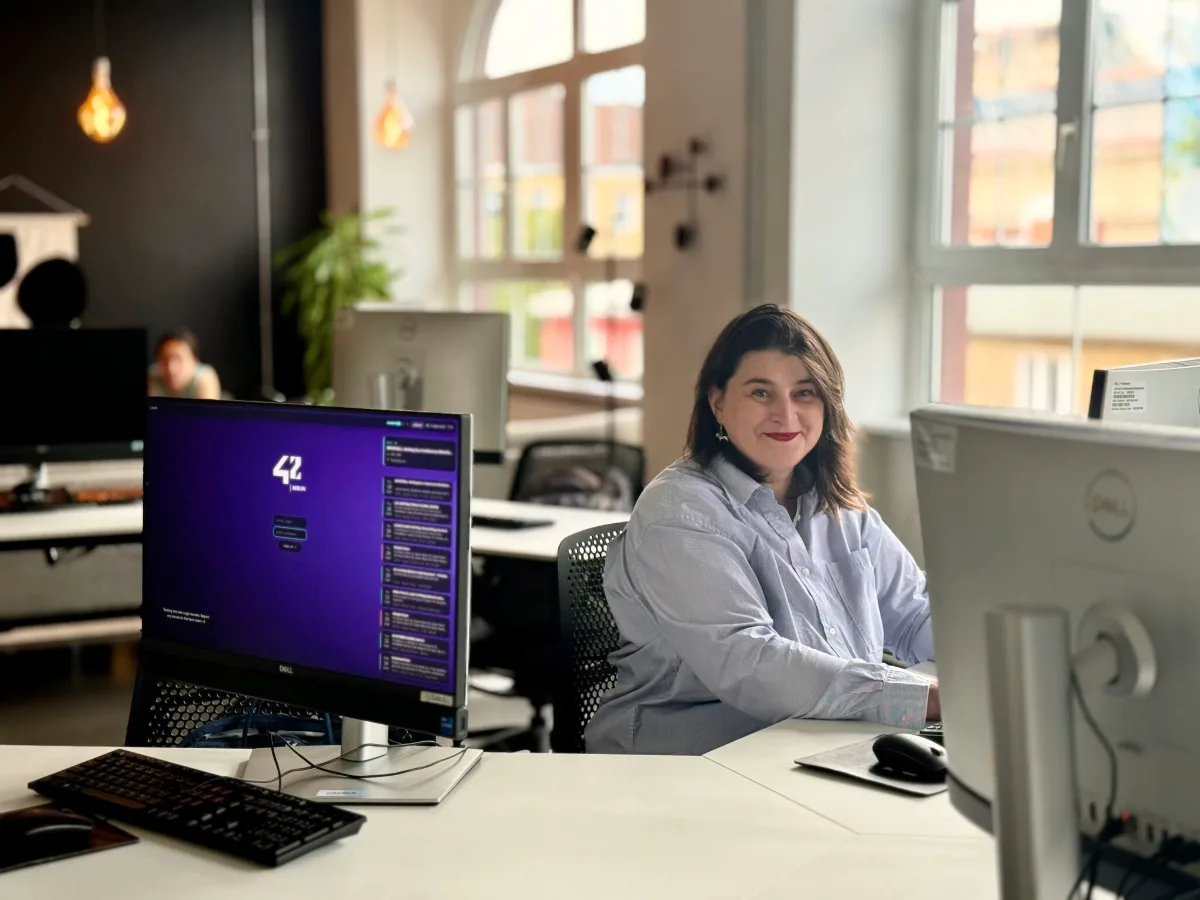
Alena used to avoid startups. They sounded like everything she didn't want: uncertainty, long hours, pressure and risk. She wanted a stable job. Today she is Founder and CEO of one, which she admits is a little ironic.
a path with detours.
She studied philology and started out as a school teacher, a job where work often ran into evenings and weekends. Later she worked as a process coordinator, in a high-pressure role where she had to decide quickly and take responsibility.
Years later she followed a long-standing interest in technology and studied computer science at Freie Universität Berlin. She did it while raising her children, and in German, a language she had only recently learned. Sometimes the children came to lectures with her.
no one telling you how.
Then came 42 Berlin. She wanted hands-on programming and a place closer to real software development: long projects, problem-solving, working with peers and owning the result. There were no lectures and no one telling her how to solve a problem. You research, experiment, fail, debug, ask for feedback and try again.
Projects in C and C++, and later full-stack development, taught her the technical side. They also taught her how to approach a problem when she didn't know the answer yet, how to work on her own and how to build things with other people.
One of her final projects, ft_transcendence, was built by a team of three. She coordinated it and owned the backend, and the team made the main decisions together. It taught her how to organise work, build a larger product as a team and connect separate parts into something that actually works.
the market had other plans.
After graduating she thought software development would finally be the predictable path. Work hard, keep improving, build good software, find a job. The market had other plans, and AI was changing the industry at the same time.
So she changed the question. What if she stopped waiting for the right opportunity and started building one? That took her into the SIBB Startups Incubator, with one of its selected projects. When the project changed direction, she reached out to two software engineers she had known for years from 42 Berlin. They joined through SIBB, and the three of them shaped what became UnityWerk.
what unitywerk does.
UnityWerk is building an AI-powered career transition platform. It starts with experienced women returning to work after a career break. It helps them see where their experience and skills carry the most value, which career directions are realistic, and what they may need to bridge the gap.
Building it has taken Alena well beyond code: understanding users, making product decisions, pitching, testing assumptions, changing direction and taking responsibility for what the team builds. She usually tries to figure things out on her own. Building a company is teaching her that nobody builds something meaningful alone.
The team wants to hear from career coaches, HR teams and return-to-work programmes, and from organisations willing to test the product in a pilot. Alena is on LinkedIn, where she has also written about it herself.
In software, you research, test, debug and try again. Building a startup feels surprisingly similar.
Alena